
What is a Flock camera?
A Flock camera reads license plates, not speed. It keeps each plate with a time and place, so the operator can search them later.
Flock says its default is to keep reads for 7 days, and each customer can set its own. 116,710 plate readers tagged Flock Safety are mapped in the US, as of November 7, 2026.
How a Flock camera works
When it senses a moving car, the camera takes a quick burst of still photos, not video. Flock’s FAQ says it takes “somewhere in the range of 6-12 images” of a car each time. At night, infrared light makes the plate stand out, while parts of the scene that don’t reflect light stay dark.

Software reads the plate and its state. It also tags the car’s make, color and type, plus things like a roof rack, a bumper sticker or a temporary plate. Each read is saved with the time, the place, the camera and the way the car was going.
Officers can search by full or partial plate, or by how the car looks. They can also get an alert when a car on a list passes, such as a stolen car or one named in an AMBER Alert. Flock says officers should check the plate and the list before a stop.
In Providence, Rhode Island, police told WPRI about one case. Nearby video showed what the car looked like. Then a plate reader search found the car and its plate. There, only 45 of the city’s 445 officers can use the system, and each user is audited every month.
Some alerts turn out to be wrong. Police in Roseville, California, found that 1,011 of 1,427 stolen or felony alerts in 2023 and 2024 were misreads. None of those misreads led to a stop or an arrest.
Flock says its default is to keep reads for 7 days. It was 30 days until August 13, 2026, and customers from before then can keep their old setting. Each customer can set its own rule.
Many agencies post their rule on a transparency portal, and EyesOnFlock lists 1,603 of these portals (Oct 14, 2026). Of the 1,595 run by public agencies, 1,520 say how long reads are kept. The most common answer is 30 days, on 1,188 portals.
The portals also show who can search the reads. Of these, 1,044 post a sharing list (Oct 14, 2026). The middle list names about 208 agencies, and the longest, the Adrian Police Department’s, names 3,870.
On September 3, 2026, two news reports added to this. Some Illinois police and sheriffs told Shaw Local they will keep reads for 30 days. In Sheboygan, Wisconsin, the mayor told FOX6 a Flock sales rep offered to sell the city five years of speed and movement data.
A contract can set a much longer time. The Inspector General for Los Angeles police found that the department’s Flock data “is stored on Flock servers for a period of five years.”
A Flock plate reader doesn’t measure speed or send tickets. Flock’s FAQ says its cameras “do not have speed detection capabilities.” Flock also says they don’t use facial recognition, and customers can’t watch a live feed from one.
Who owns Flock cameras
Flock Safety makes the cameras, and its customers run them. EyesOnFlock lists 1,603 transparency portals (Oct 14, 2026). Of these, 1,328 belong to police departments, 240 to sheriffs and 28 to schools or colleges.
On OpenStreetMap, 15,017 of the 116,710 Flock-tagged readers name who runs them (Nov 7, 2026). The tags name police departments on 8,864, stores on 3,294 and sheriffs on 1,152. They name cities or counties on 769, schools or colleges on 263 and HOAs or private communities on 224.
The most common are private operators (3,513), San Francisco Police Department (427), California Highway Patrol (CHP) (400) and Detroit Police Department (229).

Agencies also post who can search their reads. See look up your agency.
Portal figures and sharing lists: EyesOnFlock (CC BY-SA 4.0), from Flock Safety transparency portals.
What Flock cameras keep
- Records
- The plate of each car that passes, with the time and place. Often a photo of the car.
- Run by
- Most don't say. Tagged ones include private operators (3,513).
- Kept for
- Not published on the map. Each operator sets its own.
- Who sees it
- Whoever runs it, and those it shares with. In California, a public agency may share only with other public agencies in the state.
- How to ask
- Read the operator's policy. California requires one. Or ask the city for its records.
The debate over Flock cameras
Agencies say they use them to find stolen cars and missing people. Every car that passes is read and kept for a while, not only the ones on a list. How long, and who can search it, is up to whoever runs it.
California has its own rules for plate readers. Whoever runs one must have a use and privacy policy (California Civil Code §1798.90.51).
Police and other public agencies may share the data only with other public agencies in the state (California Civil Code §1798.90.55). SB 1013 would have made the rules stricter. It did not pass before August 31, 2026 (CalMatters).
Are Flock cameras legal?
Flock cameras are license plate readers, and 31 of the 50 states and DC have a law or rule on plate readers. These rules can limit how long reads are kept, who can search them or who may run a camera.
In 20 of them, no state law on plate readers was found. Find your state in the plate reader law table: each row gives the law and its source, checked October 25, 2026. You can also ask an agency for its plate-reader records.
How to find Flock cameras
116,710 plate readers tagged Flock Safety are mapped in the US. Search the map or use Near me to see the closest ones.
See the Flock camera map · Flock cameras near me · All license plate readers · Other maps compared


Flock camera questions
What does a Flock camera look like?
Many are small black cameras on a pole, often with a solar panel on top. 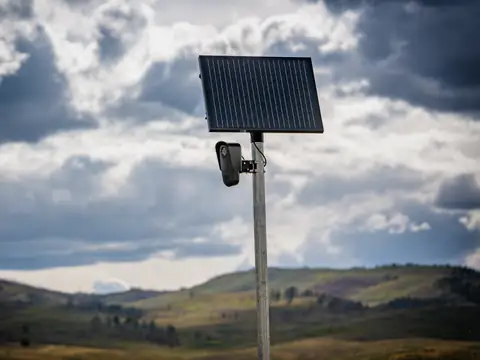 What a Flock camera looks like, in photosPhoto: Tony Webster, CC BY 4.0, cropped.

Do Flock cameras record video?
No. Flock’s FAQ says its plate readers “take still photos”: “somewhere in the range of 6-12 images” of each car that passes. Flock also sells separate video cameras, which do record video.
Do Flock cameras record audio?
Police in Independence, Kentucky, say their plate readers don’t record sound. Flock also sells a device that listens for gunshots, EFF reports. It is not a plate reader.
Can Flock cameras see what’s in your car?
Flock says its plate readers don’t use facial recognition and don’t identify drivers. The photos are of the car, but EFF notes they sometimes show the driver and passengers. At night, Flock’s FAQ says, anything that doesn’t reflect light “will be completely dark.”
Do Flock cameras take pictures of speeding cars?
They photograph each car that passes, fast or slow, but they don’t measure speed. Flock’s FAQ says its cameras “do not have speed detection capabilities,” and they don’t send speeding tickets.
Do Flock cameras automatically send alerts to police?
Yes, for cars on a list, such as stolen cars or cars named in an AMBER Alert. Flock’s FAQ says that when a camera detects a wanted car, an alert “automatically will go to local law enforcement.” Flock also says officers should check the plate and the list before a stop.
Who can see Flock camera data?
The group that runs the camera can see it, such as a police department. So can the agencies it shares with. Of the 1,044 transparency portals that post a sharing list, the middle one names about 208 agencies (Oct 14, 2026).
Can the public access Flock cameras?
No. Whoever runs a camera, such as a police department or an HOA, decides who can search it. Flock says its customers can’t watch a live feed from a plate reader. Anyone can ask an agency for its plate-reader records, and many agencies post their rules online.
How far back does Flock data go?
It depends on the agency that runs the camera. Flock says its default is 7 days. On the agency portals that state it, the most common figure is 30 days (Oct 14, 2026).
Does Flock share data with ICE?
Flock says it does not work with ICE. The sharing lists agencies post name no immigration agency, as of Oct 14, 2026. A list does not show searches one agency runs for another, or sharing that has ended.
Has Flock data reached immigration agencies?
In August 2025, the AP reported on an Illinois state audit. It found that CBP, the federal border agency, accessed Illinois data. That month, Flock paused its pilots with CBP and HSI. In October 2025, a University of Washington report found that at least 8 Washington police agencies appear to have shared with Border Patrol. In April 2026, 404 Media reported 38 Flock searches with “immigration” as the reason. Florida wildlife police ran them.
How do I find Flock cameras near me?
Use the near-me page. It finds the mapped Flock-tagged readers closest to you, and your location stays on your device.
Sources and updates
- OpenStreetMap contributors: plate readers tagged Flock Safety, data as of November 7, 2026; ODbL 1.0
- Flock Safety: Flock default retention change, August 13, 2026
- Flock Safety FAQ: still photos, night photos, speed and alerts, quoted, read October 26, 2026
- Flock Safety: how its plate readers work, October 19, 2026
- Flock Safety: “What is Flock”, no live feed from a plate reader, read October 26, 2026
- Flock Safety: its video cameras, read October 26, 2026
- WPRI Target 12: Providence, Rhode Island police practice, October 26, 2026
- Roseville Police Department: misread alerts, 2023 and 2024, read October 26, 2026
- LAPD Inspector General: review of plate readers, July 10, 2026
- EFF: what plate reader photos show, read October 26, 2026
- EFF: Flock’s gunshot audio devices, July 17, 2026
- Independence Police Department: Independence, Kentucky, the chief’s statement on its plate readers, August 2026
- Shaw Local: Illinois agencies keeping 30 days, September 3, 2026
- FOX6 Investigators: Sheboygan, Wisconsin data offer, September 3, 2026
- EyesOnFlock: agency transparency portals and sharing lists, as of October 14, 2026; CC BY-SA 4.0
- Flock Safety: “Does Flock share data with ICE?”, January 6, 2026
- Associated Press: Illinois audit and Flock’s federal pilots, August 26, 2025
- University of Washington Center for Human Rights: “Leaving the Door Wide Open”, October 21, 2025
- 404 Media: Florida wildlife police searches, April 6, 2026
- CalMatters: SB 1013 status, as of August 31, 2026
- California Legislative Information: California Civil Code §1798.90.51
- California Civil Code §1798.90.55: the rule on who a public agency may share reads with
Plate reader points are mapped by OpenStreetMap volunteers (data as of November 7, 2026).
How CamsAhead counts cameras · Report a problem · Report a camera